
Surfing La Cicer, in plain terms
What La Cicer is, why the tide matters more here than the swell, and how to work out whether today is your day. Written for people who are new to it.
Mon 14 September
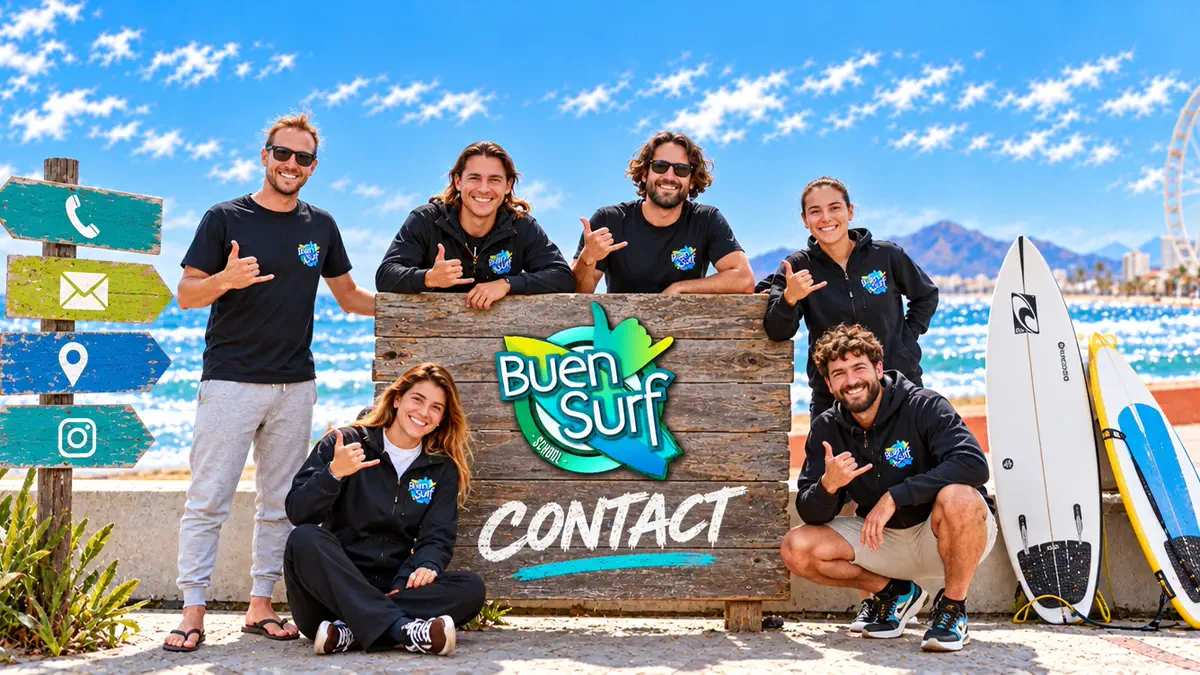
La Cicer is the southern end of Las Canteras, the city beach on the north shore of Las Palmas de Gran Canaria. Las Canteras is regularly called one of the best urban beaches in Europe, and La Cicer is the end of it where people surf. Our door is at Calle Covadonga 25, about a minute’s walk from the sand.
The one thing to understand: the barra
Las Canteras is protected along most of its length by la barra, a reef running parallel to the shore. It filters what arrives from the Atlantic. That is why the middle of the beach is famously calm and why La Cicer, past the end of the reef’s protection, is where the waves are.
Two consequences follow, and they explain most of what confuses visitors.
An offshore forecast is not the wave in front of the school. The swell height a model reports is measured out at sea. By the time it has been filtered it can be a very different thing on the sand. A number that looks alarming online is often a perfectly good beginner day here, and occasionally the reverse.
The tide changes the wave more than the swell does. Because the reef sits at a fixed depth and the water over it does not, the same swell produces a different wave at high water than at low. A day can be unsurfable at one tide and good three hours later.
This is why the live readings on our homepage are labelled as an offshore Atlantic forecast rather than as conditions at the beach. They are honest about being a signal, not an answer.
Is today a good day for a first lesson?
Mostly you do not have to work this out. We do, for every session, and if the sea is wrong for beginners we move the class rather than run it badly.
If you want to read it yourself, the rough version is: small and clean beats big and tidy, a long period between waves is better than a short one, and the tide matters enough that it is worth asking us what time is good today rather than picking a slot by your own schedule. That question is free and we like answering it.
What you actually need
For a lesson, nothing. Board, wetsuit, lycra, insurance and a certified instructor are included, and so are hot showers, a changing room and a locker for your things. Bring swimwear and something to drink.
The water here is comfortable in a wetsuit year round, which is most of why people end up staying.
Lineup manners, briefly
These are the same everywhere and they are worth knowing before your first session rather than learning them by irritating somebody.
- The surfer closest to the breaking part of the wave has priority. If somebody is already up and riding, it is their wave.
- Do not paddle straight out through the middle of where people are riding. Go around.
- Hold on to your board. A loose board is the thing most likely to hurt somebody, and it is almost always avoidable.
- If you are learning, stay in the area your instructor puts you in. It is chosen so that you are not in anybody’s way, which means you get to concentrate on surfing rather than on apologising.
When to come
We are open every day, 09:00 to 21:00. Mornings are usually calmer and less crowded. Evenings are warm and busy and good fun. Beyond that, the honest answer is that it depends on the tide, so it is worth asking.
Where to start
If you have never surfed, a beginner group lesson is the right first step: two hours, six students per instructor at most, and an instructor in the water with you rather than pointing from the sand. If you already stand up and want green waves, turns and wave reading, take the intermediate lesson instead. If you want to sharpen one specific thing, a private lesson is the faster route.
If you are here for more than a few days, buy the lessons in a pack rather than one at a time. Four lessons brings the price down to 30 EUR each, eight to 27.50, sixteen to 26.25, and you can keep them as credits and choose your days once you know what the rest of your trip looks like.